
 TechyTron
TechyTron Electric Detective STEM Kit
Discover which materials let electricity pass. Classes 3–4 · Ages 8–10 · 30–40 minutes. Coming soon.
Delivery options
Courier from ₹79.00 per order · Free above ₹999.00
Product description
For Classes 3–4, ages 8–10, with adult guidance. No coding or soldering.
Engagement: 30–40 minutes. Predict 5–10 min · Build 10 min · Test and sort 15–20 min.
Included components
- 4 CELL AA BATTERY HOLDER WITH SWITCH / COVER — 1 holder
- AA BATTERY — 4 batteries (1.5 V alkaline AA cells.)
- Regulated 5 V Power Supply with Short-Circuit Protection — 1 power supply (Supplied in a screw-closed enclosure with fitted leads.)
- Small Breadboard / Mini Solderless Board - 400 points — 1 breadboard
- Jumper Wire Combo - Male to Male, Male to Female and Female to Female Breadboard Connecting Wires (10 Qty Each) — 1 set (Colour-coded leads supplied with fitted connectors.)
- Illustrated Activity Guide and Observation Sheet — 1 set
- 5mm LED - Red Color — 1 LED
- 220 Ω 1/4 Watts (10 PCS) — 1 resistor (Quantity is individual resistors supplied in this kit; the catalogue product is a 10-piece pack.)
- Alligator Double-ended Clip Jumper Wire (10 Pcs ) — 2 test leads (Two individual insulated double-ended leads supplied.)
- Conductor and Insulator Sample Set — 1 set (Aluminium, steel, dry wood, plastic and rubber.)
Steps to make it
- Sort the samples into predictions: will light the LED or will not light the LED.
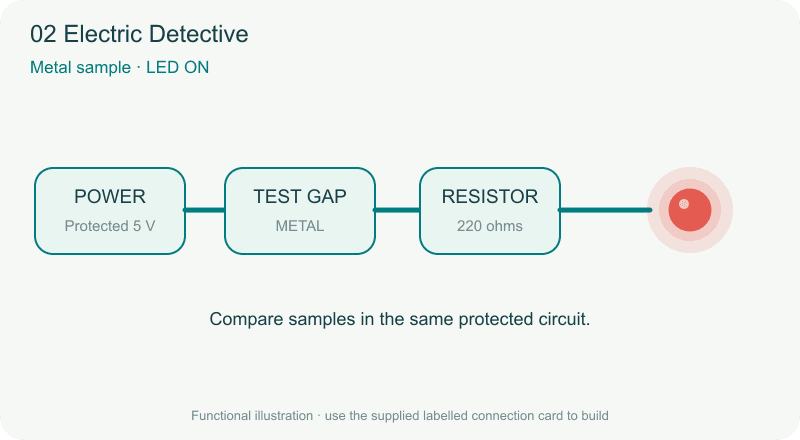
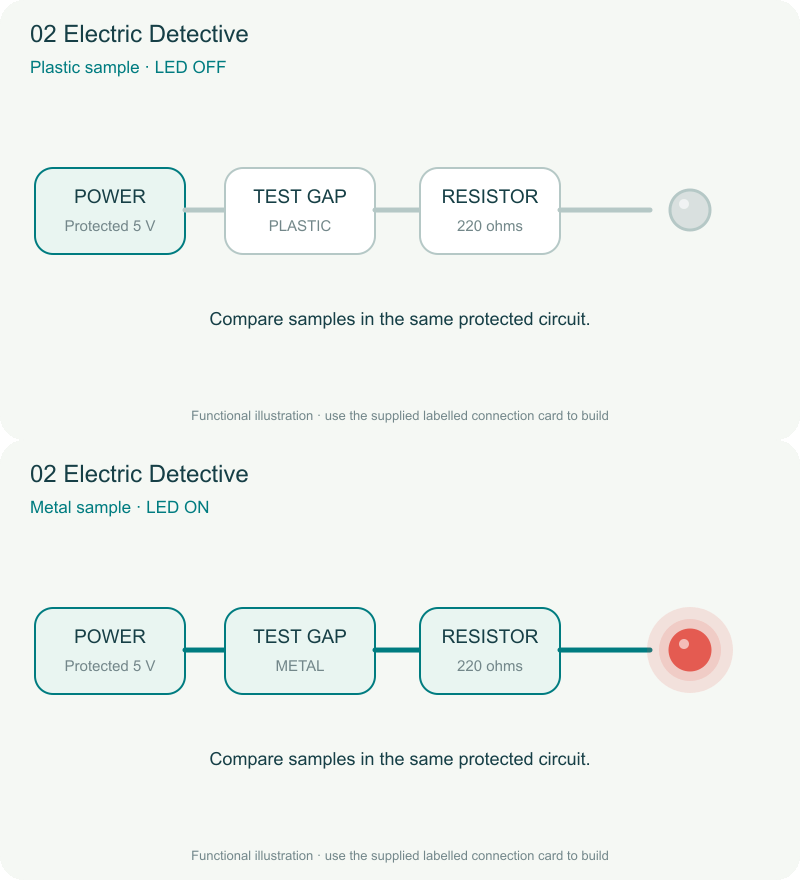
- With power off, connect power + → resistor → LED → first test clip. Connect the second test clip to power −.
- Clip an aluminium sample between the two test clips and turn on the supply.
- Observe the LED, switch off, replace the sample and repeat for every material.
- Compare your results with your predictions and sort the samples again.
What children learn
- Conductors allow enough current through this circuit to light the LED.
- Insulators resist current flow.
- A prediction can be checked by a fair test.
Test challenge
Which of the five dry materials completes the same LED circuit? Keep the battery, resistor and LED unchanged.
Observation task
For each sample, mark your prediction, whether the LED lights and your final classification.
Expected result
Clean aluminium and steel contacts should light the LED. The supplied dry wood, plastic and rubber should not.
Troubleshooting
Check clean clip-to-sample contact. A dark LED means insufficient current for this tester; it does not prove absolutely zero conductivity.
Try next
Try a coated metal sample with a prepared exposed-metal patch. Compare touching the coating and the metal.
Use and supervision
Use only the supplied low-voltage power unit. Switch power off before changing connections. Keep metal objects across the test gap only, never across the battery terminals. Keep liquids away. Adults handle battery access and inspect parts. Kit 8 uses an enclosed motor indicator, not an exposed propeller. Use the buzzer at a comfortable level away from ears.
See how it works
Download the illustrated activity guide
Coming soon. Timing is estimated for guided first use. Illustrations show the learning principle; supplied assemblies are subject to final validation.
Customer feedback
Reviews
No published reviews yet. Be the first to share useful feedback.
Shop Related in this category
Related in this category
9 catalogue productsTechyTron TechyTron
 Brightness Lab STEM Kit
 TechyTron
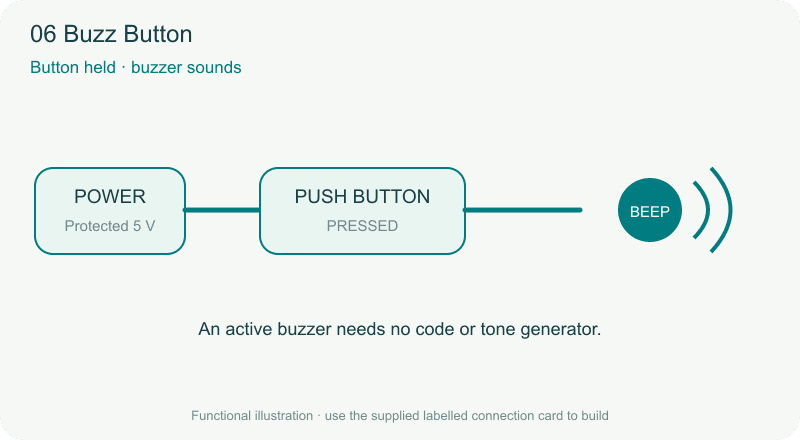
 Buzz Button STEM Kit
 TechyTron
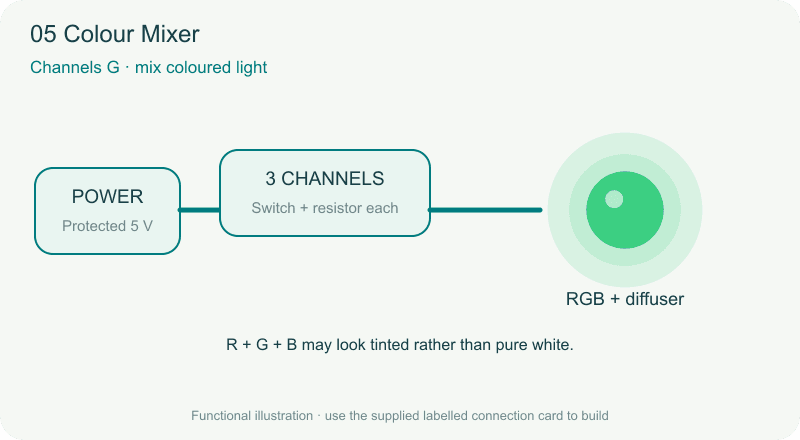
 Colour Mixer STEM Kit
 TechyTron
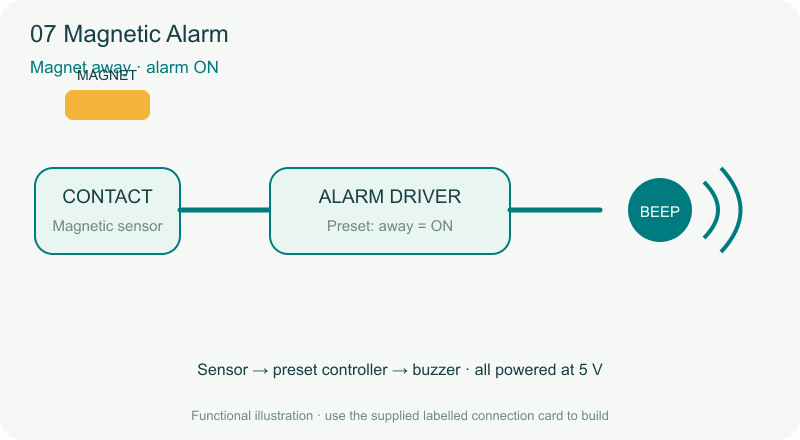
 Magnetic Alarm STEM Kit
 TechyTron
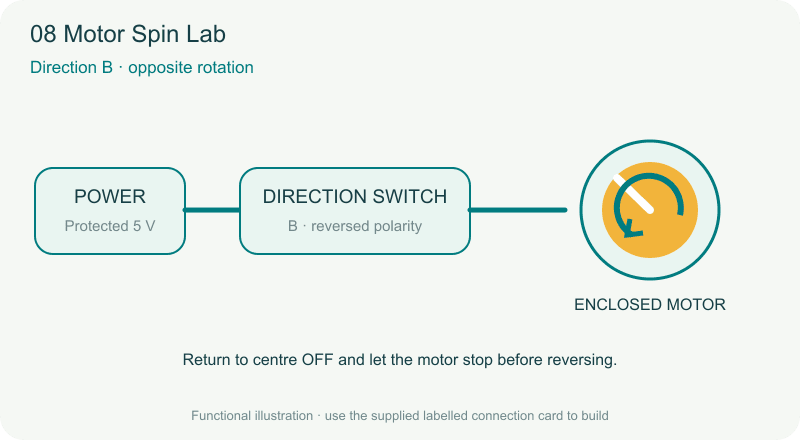
 Motor Spin Lab STEM Kit
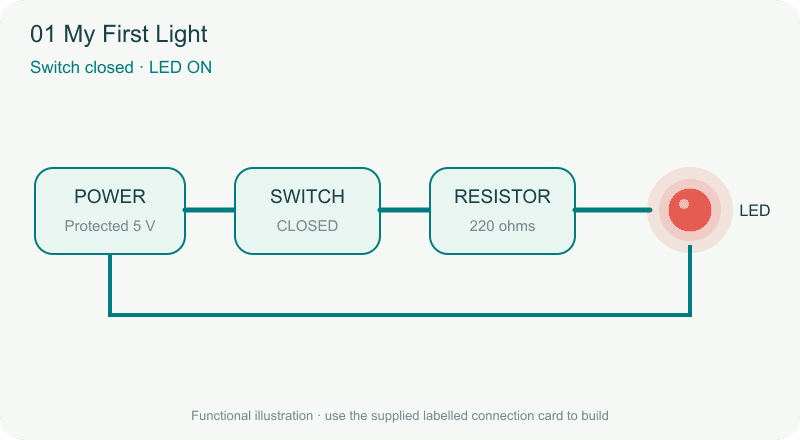 TechyTron
 My First Light STEM Kit
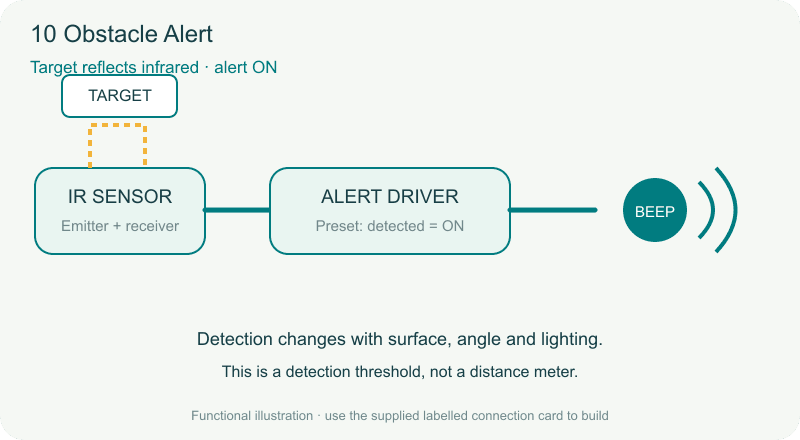 TechyTron
 Obstacle Alert STEM Kit
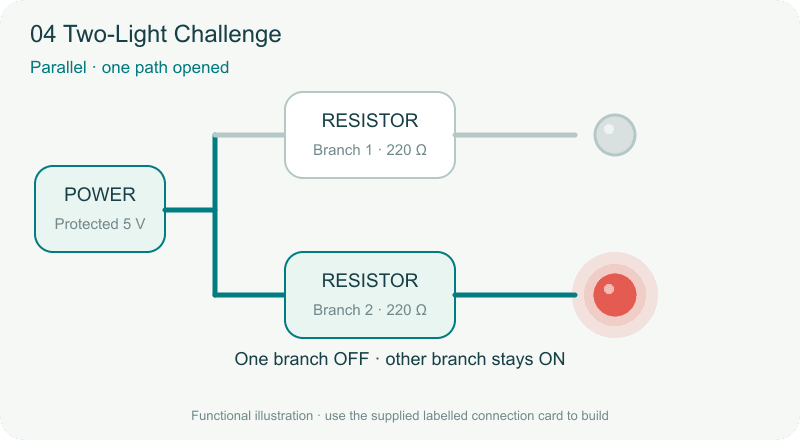 TechyTron
 Two-Light Challenge STEM Kit
Shop Related by product name